::: INAUGURAL TREATY PERIOD :::
|
December 21, 1850 - June 30, 1851
On December 21, 1850, Hawaii opened a post office at Honolulu and Henry Whitney was appointed Postmaster of Honolulu. The location of the new post office stayed at the office of The Polynesian. At first, one may have been unable to discern much difference between the letter bag service offered by The Polynesian since November 2, 1850, and the new post office. Whitney continued to use the straightline postmark he use for The Polynesian letter bag, but changed the ink color to black. He also published information concerning postage rates adopted by Hawaii and details about arrangements for sending mail to the United States and Europe.
Postal rates were high during the Inaugural Treaty Period. A letter to a San Francisco resident cost 6¢, but a letter for the East via Panama cost 40¢ per ½ ounce plus a 2¢ ship fee. On the same day the Honolulu Post Office was created, Hawaii set postage at 10¢ per ½ ounce. A letter sent in the government mail from Hawaii to New England via San Francisco and Panama thus cost 52¢. The application of the 2¢ ship varied according to whether the letter was prepaid or collect. Hawaii absorbed the ship fee on prepaid letters, reducing their cost to 50¢. For a more comprehensive look at postal rates during the Treaty Period, go to Mail Rates.
With the establishment of the Honolulu post office and also by fixing regular postage rates for the kingdom, Hawaii completed the conditions necessary for implementing the Treaty with the United States. December 21, 1850 thus is the beginning of Hawaii’s postal period and also starts the Treaty Period that would govern how mail was exchanged with the United States until June 30, 1870. The “Inaugural Treaty Period” lasted until the United States changed its internal postage rated on July 1, 1851.
|
|
|
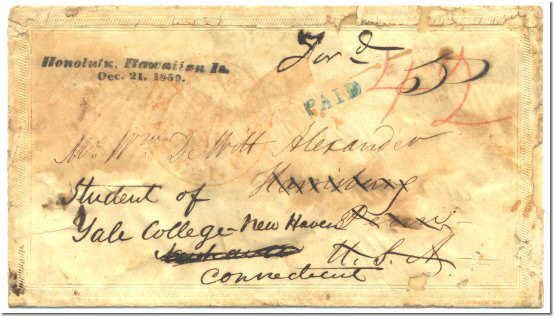
The unique first-day cover postmarked on the opening day of the Honolulu Post Office, December 21, 1850.
From the beginning of the Honolulu post office, black ink was used for applying the straightline postmark, a break from the blue ink used at The Polynesian office. The first-day cover was carried to San Francisco on the Chameleon, sailing December 21 and arriving January 22, 1851. The red San Francisco postmark can be seen left of center. This cover was sent with United States postage collect. The blue "PAID" mark was applied at Harrisburg, Pennsylvania, to indicate payment on delivery, before being forwarded to New Haven. The "42" represents United States postage to collect at Harrisburg. The "5" was added at Harrisburg to indicate the charge for forwarding the letter to New Haven, Connecticut. In addition, the sender paid 10¢ to the Honolulu Post Office, but no rate mark was used to indicate the Hawaii rate paid.
COLLECT OR PREPAID? Allowing Hawaiian residents a convenient way to prepay United States postage in Hawaii was one significant aspect of the Treaty arrangement. Until then, prepaying United States postage meant sending a letter to a friend in San Francisco accompanied with sufficient cash so the friend could prepay the letter at the San Francisco Post Office. Once the Treaty arrangement was working, the sender could pay United States postage in cash at the Honolulu Post Office. United States postage collected at Honolulu was paid to the San Francisco post office quarterly through an accounting system between the two offices.
|
|
|
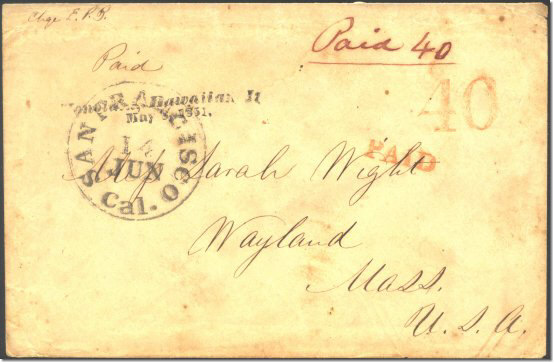
A letter sent with United States postage prepaid at the Honolulu Post Office and postmarked with the black Honolulu straightline postmark, dated May 8, 1851.
Private Express Service Between Honolulu and San Francisco:
|
|
|
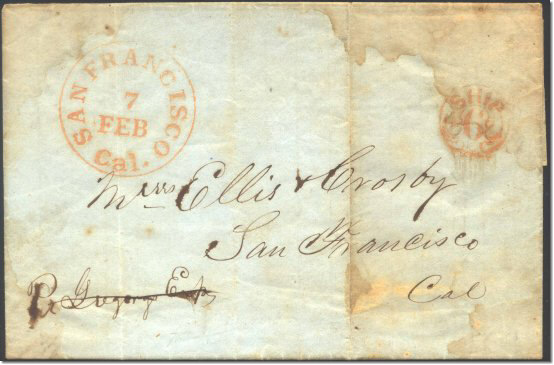
Datelined January 11, 1851 at Honolulu, this letter probably was carried to San Francisco in the private mail bag of Gregory's Express, which had opened an office in Honolulu. At San Francisco, the Gregory's Express instruction, seen at the lower left of the image, was stricken and the letter was delivered to the post office to be picked up by Ellis & Crosby. If this analysis is accurate, the sender received little advantage by having the letter carried by Gregory's Express.
Other examples of Honolulu straightline postmarks:
|
|
|
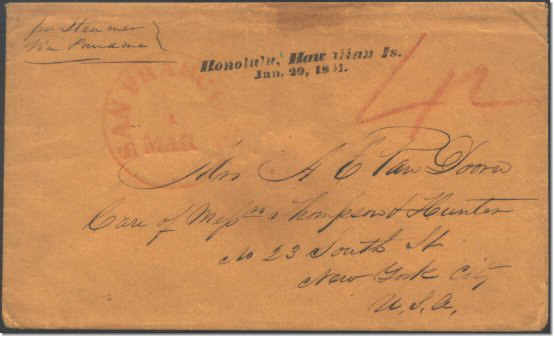
A collect cover dated January 29, 1851
|
|
|
|
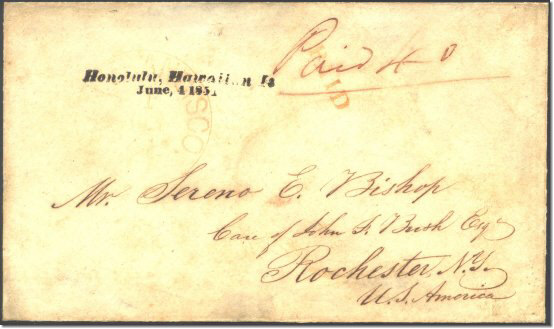
A prepaid letter dated June 4, 1851
|
|
END OF THE INAUGURAL TREATY PERIOD: The first change in United States domestic postage following implementation of the Treaty arrangement was effective July 1, 1851, when the 40¢ rate on via Panama mail was reduced to 6¢ for prepaid or 10¢ for collect. This change put an end to the Inaugural Treaty Period.
 For a record of covers from the Inaugural Treaty
Period
For a record of covers from the Inaugural Treaty
Period
Please E-mail (scott312@earthlink.net) me if you have information about other covers or if you can provide images of any recorded covers in the list.
|
BIBLIOGRAPHY
- Gregory, Fred F., Hawaii Foreign Mail to 1870, The Philatelic Foundation, 2012, the definitive work for this period, including illustrations of all straightline cover for which images are known.
- Wheeler, Frederic A., "The Honolulu Straight-Line and Its Historical Background", The American Philatelist, Vol. 99, No. 1 [1008], p. 21-35, January, 1985; untitled letter to editor, Vol. 99, No. 5 [1,012], p. 396, May, 1985; "An Addendum," The American Philatelist, Vol. 102, p. 873-874, Sept., 1988. A superb article with photographs of most of the 30 covers identified; quotes pertinent letters and newspaper notices; very well researched but ship rate analysis gets confused; essential for any student of early postal history.
|
|
|

|
|
Copyright © 1999 - 2013 POST OFFICE IN PARADISE. All rights reserved.
|
|