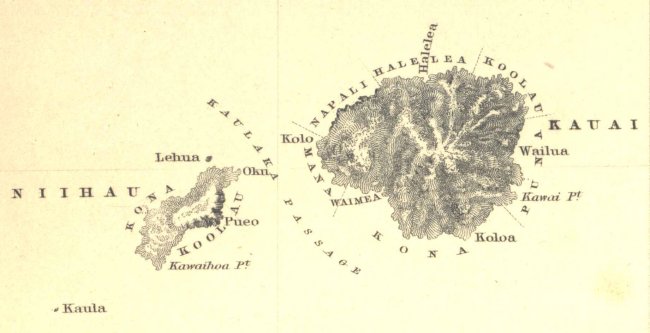
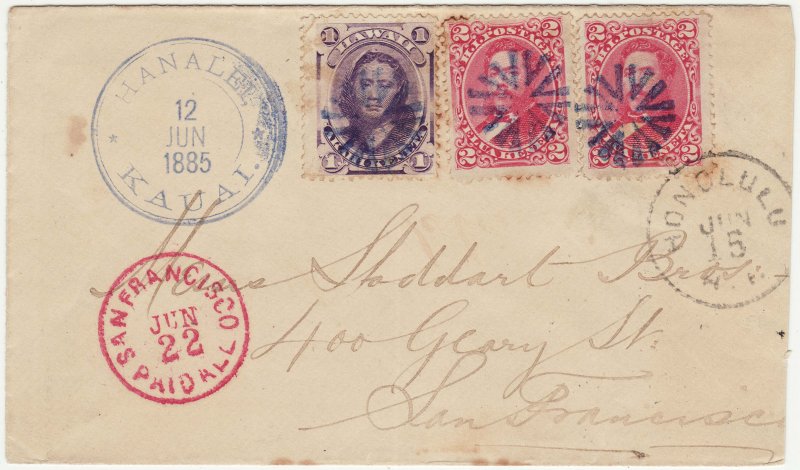
At the northwest end of the main island chain lay the islands of Kauai and Niihau, the latter privately owned even today. Kamehameha I never conquered these islands by force, but ultimately took them over by an agreement made with the king of Kauai. Mostly lush and wet, Kauai was dubbed the "Garden Isle" by early 19th Century voyagers in search of vegetables and fruits to replenish supplies. Niihau was known then for its sweet potatoes. Kauai's center is largely uninhabitable – a region of steep, wet cliffs climbing to a summit thought to be the wettest place on earth. Population centers have ringed the coastline and spread up onto the coastal plains, except few people lived along the rugged valleys and steep cliffs dominating the northwest coast.
The impassable cliffs of the northwest Napali Coast make it impossible to drive the entire circumference of Kauai. However, Kauai is easily traveled from Haena Point at the extreme northwest tip to Mana at the western tip, if one goes east from Haena Point or Mana and stays to the northern, eastern and southern coasts. Kauai is small compared to Hawaii or Maui so a rider on horseback could make it from the north end to the south end in good time. By 1875, Whitney wrote in his Guide to Hawaii that a light vehicle could be driven the 65 miles from Hanalei to Mana Point, via Lihue. Schooners frequently operated between Honolulu and the main Kauai harbors at Waimea, Koloa, Nawiliwili and Hanalei. Steamer service was spotty until the 1880s when Nawiliwili and Hanalei became weekly stops.
For discussions of overland routes and sea routes for these islands, see
Routes and Post Offices
under Local and Inter-island Mail.
POST OFFICES
Customs collectors were appointed for three harbors on Kauai, beginning with Hanalei in 1846 and followed by Waimea (1850) and Koloa (1856). The first post office for the island, apart from customs collectors who were ex officio postmasters at their ports, was at Nawiliwili, the harbor for the Lihue District. The first Nawiliwili post office actually was at Judge Bond's house near Lihue, but was moved to the harbor where it could be of better service. In 1856, post offices were opened at Waimea and Hanalei when postal duties were transferred from the customs collector to appointed post masters at those towns. Also in 1856, post offices were opened at Koloa and Anahola. A sixth post office was opened at Hanapepe in 1858. The 1860's saw some retrenchment on Kauai as on other islands because of the loss of income from the whaling industry. Hanapepe office closed in 1866 and Anahola closed in 1869. A post office existed for a short time at Moloaa (1864-1870) and a new office was opened at Lihue (1868). In 1870, the post office at Nawiliwili was closed and its operation was absorbed by the Lihue office. Thus, at the end of 1870, Kauai had four post offices: Hanalei, Koloa, Lihue and Waimea.
One office, at Kilauea, was opened in 1877, so Kauai had five offices at the start of 1880. A sixth office, at Kapaa, was opened that year and a seventh office, at Kekaha, was opened in 1882. Kauai had eight offices in 1890 when the office at Makaweli was opened that year. In the 1890s, one office (Kapaa) was closed in 1893 and replaced by a new office (Kealia), Hanapepe re-opened (1893) and new offices were opened at Mana (1893) and Eleele (1899). Kauai thus had eleven offices open at 1900.
Niihau had no post offices. However, the Sinclair family kept postage stamps on hand to use on any mail sent from the island via Waimea on Kauai. Mrs. Sinclair resided on the island from 1863 to 1876. Mail service for the island was arranged by the postmaster at Waimea until 1873, when the Sinclair family took over the job of arranging a boat.
POSTMARKS
 Back to