::: MIDDLE TREATY PERIOD :::
|
MAY 16, 1855 TO AUGUST 30, 1863
When the United States adopted new rates effective April 1, 1855, only prepaid mail to the East via Panama was
affected. The former rate of 6¢ was increased to 10¢. With the 2¢ ship fee and the Hawaii rate of 5¢, the cost of
a prepaid letter from Hawaii was thus increased from 13¢ to 17¢.
|
|
|
A cover postmarked at Honolulu on August 11, 1855, with Hawaii and United States postage prepaid with stamps
(Hawaii No. 5 and four United States No. 11) at the 1855 United States rate for prepaid letters sent via Panama.
(Courtesy of Gary Peters)
Collect letters and stampless prepaid letters were allowed to enter the United States postal system if they
originated outside the United States (prepayment of United States postage by stamps was made mandatory by the 1855
law on letters originating in the United States). A stampless prepaid letter cost the same as a stamped prepaid
letter, with cash or a Hawaii stamp used to pay Hawaii postage, and cash used to prepay United States postage. In
the case of prepaid stampless letters, the Honolulu Post Office account at the San Francisco Post Office was
charged with the postage. The account was settled on a quarterly basis.
|
|
|
A prepaid stampless letter sent from Hawaii to Connecticut via San Francisco and Panama, postmarked at Honolulu
on July 28, 1855. With the United States postal act of 1855, pre-payment of United States postage with stamps was
made mandatory. However stampless letters, both prepaid and collect, originating in a foreign country continued
to be accepted. A pencil notation on this cover directs the Honolulu Post Office to charge Hawaii and United
States postage to the Honolulu firm of Castle & Cooke. The San Francisco Post Office charged United States postage
to the Honolulu Post Office account kept at the San Francisco Post Office.
News of the rate change on prepaid letters was slow to reach Hawaii and finally arrived on May 16, 1855.
See Mail Rates. August 30, 1863 is used as the termination date of the Middle
Treaty Period because on that date Hawaii learned of a reduction in United States postage, effective July 1, 1863.
The rate for a letter sent with United States postage collect remained at 10¢ (12¢ with the ship fee). Thus, in
the 1855 rate period a collect letter cost the same as a prepaid letter. Payment of Hawaii 5¢ postage remained
mandatory. Hawaii postage could be paid in cash or with stamps.
|
|
|
Letters sent with United States postage unpaid also cost 12¢ during the 1855 rate period, because the 1851 rate
for collect letters was unchanged by the 1855 law. As always, payment of Hawaii postage by stamps or cash was
mandatory. This cover postmarked at Honolulu on April 8, 1857, was sent with United States postage unpaid.
Payment of Hawaii postage with stamps became a problem in 1856-1857, when the Honolulu Post Office ran out of 5¢
stamps. At the start of the rate period in May, 1855, the available 5¢ stamp was the 1853 Boston Engraved Issue
(Scott No. 5) See Boston Engraved Issue.
|
|
|
Payment of Hawaii postage with stamps meant using a Hawaii 5¢ stamp – one stamp paid a single rate. This cover
postmarked at Honolulu on December 8, 1856, was sent with United States postage collect and Hawaii postage paid
with a 5¢ 1853 Boston Engraved stamp.
When the Honolulu Post Office ran short of 5¢ stamps, it placed a new order from the same Boston printer who had
made the 1853 issue. That order finally was received in mid-1857. Meanwhile, Hawaii resorted to provisional use
of the 13¢ stamps made obsolete when the United States increased the prepaid rate in 1855. At first, the 13¢
stamp was used as a 5¢ stamp without any notation on the stamp itself. Post Office records probably reflected they
were sold for 5¢, but those records have not been located.
|
|
|
A 13¢ Hawaii stamp postmarked in September, 1856, with the Honolulu collect letter postmark, indicating the 13¢
stamp was used as a 5¢ stamp when the supply of 5¢ stamps was exhausted.
In 1857, the Honolulu Postmaster decided to surcharge the 13¢ stamps with a "5" to indicate their use as 5¢ stamps.
Stamps bearing the numeral "5" are listed as Hawaii Scott No. 7. For a census of Scott No. 7 covers,
See Scott No. 7 Covers.
|
|
|
A cover postmarked June 27, 1857 at Honolulu, with Hawaii postage paid with a provisional surcharge "5" on the
13¢ stamp (Hawaii Scott No. 7), and United States postage prepaid with a twelve cents stamp of the 1851 Issue
(United States Scott No. 17).
Honolulu re-ordered the 5¢ stamps and received the stamps of the second printing (Scott No. 8) in mid-1857. Some of the old 5¢ stamps
were still in the hands of patrons so Scott No. 5 covers continue to appear in the record of surviving covers until October, 1860. The
census of Scott No. 5 covers is set out at Early Treaty Period - Scott No. 5.
Use of the new 5¢ stamps began by June 27, 1857, the earliest recorded date. The cover census lists 82 covers bearing a 5¢ Scott
No. 8. The latest use is recorded in 1863.
|
|
|
A cover postmarked November 9 at Honolulu and November 28, 1861 at San Francisco and sent to Wayland, Massachusetts, via
San Francisco and the Daily Overland Mail stage to St. Louis, Missouri, where it was loaded on the railroad for the East. From Honolulu,
the cover was carried to San Francisco by the American clipper ship Speedwell, departing Honolulu November 9 and arriving San
Francisco November 27.
In time, the supply of Scott No. 8 covers was diminished and a third order was placed for more 5¢ stamps. Stamps from the third order
were received in mid-1861 and are designated Scott No. 9. There are 49 recorded Scott No. 9 covers, starting with one postmarked in
early September, 1861. This stamp remained valid for paying the Hawaii foreign mail postage rate so Scott No. 9 uses continued into
the Late Treaty Period. A census of Scott No. 9 covers is set out
at Scott No. 9 Covers.
Later, in 1861, the Honolulu Post Office ran short of United States 12¢ stamps and resorted to another provisional
use of the 13¢ 1853 Boston Engraved stamp. This time, it was used as a 12¢ United States stamp at the Lahaina Post
Office, to show the Honolulu Post Office when United States postage was prepaid so it would be listed on the
prepaid letter way-bill when sent to San Francisco. No inscription was marked on the 13¢ stamp to indicate this
use. An example may be seen at Boston Engraved.
At the outset of the 1855 rate period, the cost of sending a letter for delivery at San Francisco remained the
same as before – a 6¢ ship fee. The ship fee remained the same regardless of weight.
|
|
|
This letter postmarked at Honolulu on June 5, 1855, was addressed for delivery at San Francisco. As in the
earlier rate periods, the cost remained 6¢, as indicated by the San Francisco SHIP/6 clamshell rate mark. Hawaii
postage of 5¢ was paid in cash.
After ten years of use, the San Francisco SHIP/6 clamshell mark became so worn it lost the design and printed only
the bare minimum information required.
|
|
|
Postmarked November 26 at Honolulu and December 19, 1860 at San Francisco. The clamshell "SHIP/6" marking was
just about worn out and this cover bears the last recorded strike of it on mail from Hawaii.
Effective April 1, 1861, the United States rate on letters addressed for delivery in San Francisco was reduced to
a 5¢ ship fee. Meanwhile, Hawaii ordered a new supply of the 5¢ Boston Engraved stamps. These stamps were received
in 1861 and were printed on bluish paper (Hawaii Scott No. 9).
|
|
|
A letter postmarked at Honolulu on July 16, 1862, addressed for delivery in San Francisco, was charged 5¢ under
the 1861 United States rate amendment, as indicated by the SHIP/5 applied at San Francisco. Hawaii postage was
paid with a 5¢ 1861 Boston Engraved stamp (Hawaii Scott No. 9).
Letters sent to West Coast addresses beyond San Francisco cost 5¢ throughout the 1855 rate period, unchanged from
the 1851 rate period. This rate was comprised of United States postage of 3¢ and a ship fee of 2¢, so the postage
portion was doubled for each rate over one-half ounce. At first, San Francisco used a simple "5" with the word
"SHIP" to show the rate.
|
|
|
This letter was postmarked at Honolulu on November 3, 1855, and addressed to Salt Lake City, Utah. Hawaii
postage was paid with an 1853 5¢ stamp (Hawaii Scott No. 5) and United States postage of 5¢ was collected on
delivery. (Courtesy of Steven Walske)
Later in the 1855 rate period, the San Francisco Post Office began using the arced SHIP/5 to show postage due from
the addressee.
|
|
|
A letter postmarked at Honolulu on September 24, 1861, and addressed to Sierra County, California, shows the
San Francisco arced SHIP/5 to indicate the amount due from the addressee. Hawaii postage was paid in cash.
We travel through this Period with relatively little rate confusion, but we encounter a greater variety of Hawaii
Boston Engraved stamps, and United States stamps, and a progression of postmarks to make the Period interesting.
See San Francisco Postmarks and
Honolulu Postmarks. This Period also witnesses the next great change in how mail
traveled from San Francisco to the East, with the introduction in 1858 of the Butterfield Stage from San Francisco
across the Southern Route via Los Angeles and El Paso to St. Louis. After stage service began in 1858, a letter was
carried to the East by stagecoach if the sender designated it to go "overland", otherwise it was sent via Panama
unless it was specially endorsed to go overland. In late 1859, the practice was reversed so far as letters were
concerned and mail was sent overland unless specially endorsed to go by steamer via Panama. In 1861, as the United
States entered upon its Civil War, the stage line was relocated, amidst murky ownership changes, to the Central
Overland Route via Salt Lake. In the middle of the relocation was the Pony Express which, despite its romantic
history, carried little mail but proved the viability of the central route. Given the semi-weekly coach departures
of the Butterfield stage and the daily departures of the Central Overland Mail, San Francisco dates on mail carried
by coach more closely tie to the date the cover arrived at San Francisco - but mail still was postmarked normally
when it left San Francisco.
At the start of the Middle Period Hawaii put into use an oval PAID rate mark (MH #761)
See Hawaii Rate Marks. This device had been obtained in 1851 but apparently
was put aside as unnecessary at the time. Now, perhaps to emphasize the fact of prepayment, it was used for a few
months on stampless prepaid letters. Interestingly, for the first two mail shipments under the new rate (May 17
and June 5, 1855), Honolulu used its collect mail postmark even on prepaid mail (perhaps evidencing some concern
over the effective date of the new rate and wanting to avoid a charge-back of unpaid postage). From May 12 to
November 13, 1855, fifteen covers are recorded with the oval mark enclosing a manuscript rate
See Paid Oval Covers. Please send me an E-mail
(scott312@earthlink.net) with information about other oval mark covers.
|
|
|
Postmarked May 17 at Honolulu and June 16 at San Francisco. A pair of United States 3¢ stamps (United States
Scott No. 11) are lifted to show the PAID oval beneath with a manuscript 6¢ entered in red crayon. This cover was
carried to San Francisco on the American bark Archibald Gracie in the first mail bag sent from Honolulu after the
new rate on prepaid mail to the East was known there. However, this cover was unaffected by the rate change, as it
was a prepaid letter to Oregon. The Archibald Gracie departed Honolulu May 17, 1855 and arrived San Francisco on
June 6. The steamer for Oregon departed June 16. In my opinion, the United States stamps on this cover were added
at Honolulu to eliminate any confusion about the prepayment of mail to Oregon. At the time, there was uncertainty
in Honolulu about the Oregon rate and 6¢ is an overpayment of the 5¢ rate and, in any event, Honolulu had no
United States 5¢ stamps. San Francisco probably would not have made that mistake. Only two covers with the oval
bear United States stamps pasted over the oval mark.
|
|
|
This prepaid cover postmarked at Honolulu on November 3, 1855, shows the oval PAID mark with the "via Panama"
12¢ rate indicated. The San Francisco Post Office marked it with its straightline "PAID 12" to indicate postage
was prepaid, and charged the Honolulu Post Office account 12¢.
|
|
|
A double weight letter sent via Panama cost 22¢ United States postage, as shown on this cover postmarked at
Honolulu on June 5, 1855. The rate consisted of twenty cents postage and two cents for the ship fee. In this case
Hawaii and United States postage was paid in Honolulu in cash and 22¢ was charged to the Honolulu Post Office
account at the San Francisco Post Office.
In September, 1858, overland stagecoach mail service between San Francisco and Missouri (and thence to the East by
rail), became a viable option for Hawaii mail when the Butterfield Overland Stage began operation. The route went
via Los Angeles, Tucson, El Paso, and Ft. Smith. Semi-weekly stages carried the mail through to St. Joseph,
Missouri, about as fast as the steamships. Letters went by steamship via Panama unless they were endorsed to go
"overland" until January, 1860, when the stagecoach line became the default and a letter was carried by steamship
only if it was endorsed to go that way. Whether a letter was carried by coach or steamship, the postage rate was
the same. Despite the regulations, numerous Hawaii covers went by stage without endorsement, perhaps because the
route was indicated on the way-bill accompanying the letter bag or on some other writing. San Francisco began
using a handstamped "OVERLAND" mark in 1859.
|
|
|
San Francisco's "OVERLAND" handstamp, seen on this 1859 collect cover, was used to designated transit by
stagecoach from San Francisco to Missouri on the Butterfield Overland stage begun in September, 1858.
In 1861, the southern route used by the Butterfield stage was closed with the onset of the Civil War, and its
operations were moved to the Central Route, between Placerville, California and Missouri, via Salt Lake City. This
route was used earlier, primarily for intermountain mail to Nevada and Utah, and also was being used by the fabled
Pony Express. Transcontinental letters carried by the Butterfield stage began moving across the Central Route on
July 1, 1861.
|
|
|
Postmarked at Honolulu on June 8, 1861, and at San Francisco on June 29, this Hawaii cover sent collect to
Pennsylvania was among the letters carried on the first trip of the Butterfield stages on the Central Route after
the southern route was closed due to the onset of the Civil War. Hawaii postage on this letter was paid with a
Hawaii 5¢ 1861 Boston Engraved stamp and United States postage of 12¢ was collected on delivery.
ABOUT THE MIDDLE PERIOD COVERS
My census lists 541 covers or large cover remnants sent from Hawaii during the Middle Treaty Period. Of these, 354
were prepaid and 160 were sent with United States postage unpaid (the balance were privately carried, or postage
free covers to the United States, or covers sent direct to non-United States ports). Judging from the surviving
covers, collect mail was less popular than prepaid mail. Stampless covers number 259 (including free letters,
letters sent to non-U.S. ports and privately carried letters) and covers prepaying United States postage with
stamps number 238. The number of covers paying Hawaii postage with stamps, but with United States postage collect
is 34. As the Period wore on, the number of stampless covers dwindled. The year 1860 was the last year when
stampless covers outnumber stamped covers. Before 1861, stamped covers outnumber stampless only in the year 1857.
After 1860, stamped covers prepaying United States postage heavily outnumber stampless covers (81 stamped covers
to only 27 stampless). These numbers omit covers with portions lost so it cannot be determined whether they bore
stamps when mailed.
|

 Study of Covers bearing United States Stamps in the Middle Treaty Period
Study of Covers to foreign destinations sent through the United States
Study of Privately Handled Covers in the Middle Treaty Period
|
POSTMARKS NEVER LIE?
Generally, postmark dates are reliable. But they were sometimes wrong.
|
|
|
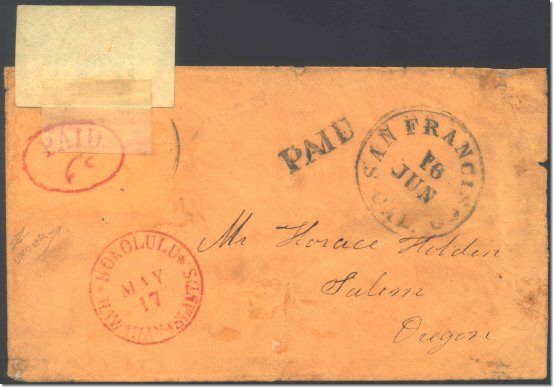
What have we here? This cover is postmarked January 12 at Honolulu and March 5, 1858 at San Francisco. So what's
wrong? The handwritten note in the lower left corner reads "Per Morning Star," the missionary ship supplying
mission stations in the South Pacific. But in 1858, the Morning Star arrived at Honolulu from Ascension Island on
January 28 so the January 12 postmark must be incorrect. Moreover, we record four covers with the San Francisco
March 5 postmark, two bearing March 5, 1858 and two with March 5, 1859. One of the two with a March 5, "1858"
postmark has contents datelined September 24, 1858 at Ponape on Ascension Island, so the 1858 date in the San
Francisco postmark must be wrong. In 1859, the Morning Star arrived at Honolulu from the South Pacific on January
24, still too late for the Honolulu postmark. The Honolulu postmark should be February 12 instead of January 12
and the San Francisco postmark should be March 5, 1859. To further prove the point, none of the 1858 sailings make
sense. The American bark Melita departed Honolulu February 12, 1859 and arrived San Francisco March 3, in time for
the Panama steamer sailing on March 5. Please E-mail (scott312@earthlink.net) me if you
have information on the cover with the Ponape contents. Apart from interest in the postmark mistakes,
the Morning Star cover above is an example of mail from elsewhere in the Pacific being sent to the United States
via Hawaii. Missionary mail was carried free of charge on the Morning Star and was first entered into an official
postal system upon arrival at Honolulu.
INBOUND LETTERS
A rate change on inbound letters took place in November, 1856. Until then, the Honolulu Post Office paid the 2¢
ship fee from the 5¢ collected on each inbound letter. Postmaster Joseph Jackson replaced Whitney in July, 1856
and soon afterward obtained permission to charge 7¢ on each inbound letter. Treatment of inbound letters thus
became the same as outbound letters in the sense that the postal patron paid the 2¢ ship fee in both cases. It
became less common in this Period for inbound letters to be addressed to an agent in San Francisco, except it was
a usual practice for letters originating in Europe.
END OF THE MIDDLE TREATY PERIOD
|
|
|
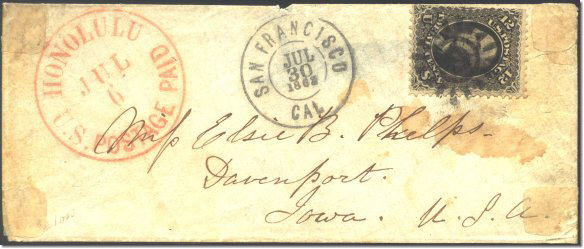
Postmarked July 6 at Honolulu and July 30, 1863 at San Francisco, this letter was franked with postage (12¢ US
Scott No. 69) sufficient for the 1855 rates although on July 1, 1863, the United States letter rate was reduced to
just 3¢ which, with the 2¢ ship rate made the total United States postage on a letter just 5¢ from Hawaii. News of
this rate change was late in reaching Honolulu and finally arrived August 30, 1863. Letters such as this one sent
by the American bark Comet on July 6, 1863, continued to be paid at the old rate.
|
|
BIBLIOGRAPHY
|
- Kemble, John Haskell, The Panama Route 1848-1869, University of California
Press, Berkeley and Los Angeles, 1943. An essential reference for the Panama Route.
- Hafen, LeRoy R., The Overland Mail, Arthur H. Clark Company, 1926; Quarterman
edition, 1976. U.S. Overland Routes including the Butterfield Southern Route and
the Central Route; a key reference work.
- Hahn, Mannel, "The U.S. Post Office 1851-1860", Chapter XXXVI, The United States
One Cent Stamp Of 1851-1857, Vol. II by Stanley B. Ashbrook, H.L. Lindquist, New
York, 1938. This chapter of Ashbrook's famous book was written by Hahn and
addresses U.S. mail development and rates of the period.
- Jackson, W. Turrentine, "A New Look at Wells Fargo, Stagecoaches and the Pony
Express", California Historical Society Quarterly, p. 291-324, December, 1966. U.S.
Central Overland Route; excellent analysis of Wells Fargo's formation, development
and relationships with other overland carriers.
- Jackson, W. Turrentine, "Wells Fargo/Staging over the Sierra", California
Historical Society Quarterly, p. 99-133, June, 1970. U.S. Central Overland Route.
- Nathan, Mel C. and Boggs, W.S., The Pony Express, with foreword by Roy S. Bloss,
Collectors Club Handbook No. 15, Collectors Club, Inc., N.Y., 1962. Authoritative
work on the pony express; includes departure and arrival dates of known covers,
history of the service and routes; gives details on the stamps used.
- Wiltsee, Ernest A., Gold Rush Steamers, The Grabhorn Press, San Francisco, 1938.
The definitive work on the Panama Route, particularly in reference to the contracts,
details of service and alternative routes.
|
|

|
|
Copyright © 1999 - 2010 POST OFFICE IN PARADISE. All rights reserved.
|
|







![59 - Jan 12 [sic - Feb 21] cover Morning Star](foreign/midtreaty/59jan12cms.jpg)