::: UPU Taxed Letters and Cards :::
|
|
 Back to UPU Period.
|
TAXED LETTERS
Unpaid or underpaid letters were forwarded to their destination under UPU rules.
However, the recipient was charged double the deficient postage. For tax marks used on
foreign mail at Honolulu, see Service Marks.
|
|
|
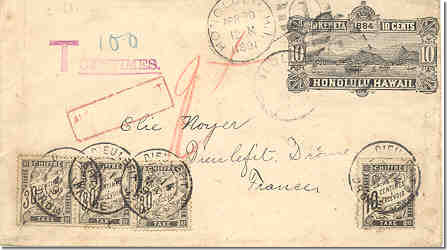
Postmarked April 21, 1891 and franked with the 10¢ postal envelope, UPSS 10, this
franking was sufficient for a single letter to France in 1891. The problem is it needed
another 20¢ for a triple weight letter. Postage due marks applied in Hawaii on outbound
covers expressed the amount of deficient postage in French centimes. The receiving
country would translate that amount into the local currency using the UPU currency
equivalency scale adopted at the most recent UPU Conference. Double the deficient
postage was then charged to the recipient. In this case, 20¢ in Hawaii was the
equivalent of 100 French centimes. France doubled that amount to collect from the recipient. The purple marking
with a "T" and "CENTIMES" was applied at Honolulu.
See Service Marks. The amount due was larger than the
handstamps available to the Honolulu postal clerks so a "100" was written in by hand.
The cover was marked with an indistinct red boxed American Packet rectangle on its way
to France where the recipient had to pay 100 French centimes to receive it. The French
postage due stamps amount to 100 centimes.
|
|
|
The recipient of this official letter must have been irked when he had to pay 10¢ because
some clerk in the Hawaiian Department of Foreign Affairs applied only a 5¢ stamp for a
double weight letter. The cover is postmarked October 31, 1893 and is franked with the
overprinted 5¢ Scott No. 59. The black "U.S. CHARGE/TO COLLECT" with "10 CENTS" was
applied at San Francisco. The 5¢ deficient postage was equivalent to 25 French centimes
and that amount equated to 5¢ in United States currency, doubled to 10¢ to collect from
the recipient.
|
|
|
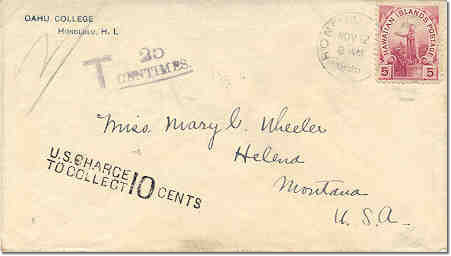
Another example of a double weight letter franked with only a 5¢ stamp, in this case the
5¢ Scott No. 76. It was postmarked November 12, 1896.
|
|
|
|
|
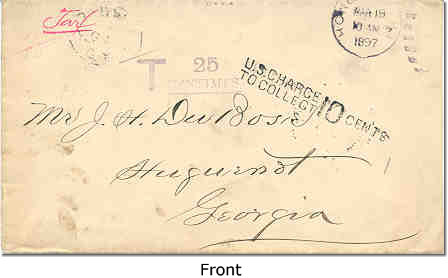
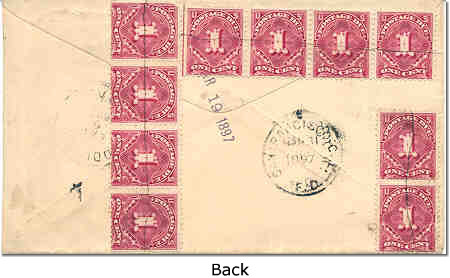
Front and back of a single weight unpaid cover so the recipient was required to pay 10¢
to the postmaster in Huguenot, Georgia. It was postmarked April 19, 1897 at Honolulu
and United States postage due stamps amounting to 10¢ were applied to the back.
UNPAID OR UNDERPAID SOLDIERS MAIL
American soldiers stationed in Hawaii or stopping there en route to or from the
Philippines during the Spanish American War or the subsequent war with the Philippine
Insurgents were entitled to a special rate of 2¢ after August 12, 1898. Moreover, their
unpaid or underpaid letters were taxed only the exact amount of deficient postage.
See Soldiers Mail.
|
|
|
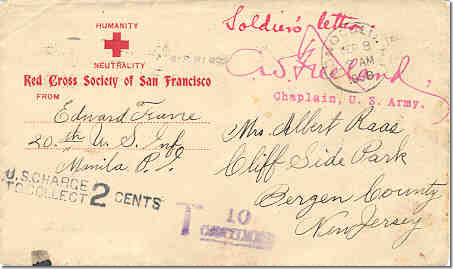
Postmarked September 8, 1898 at Honolulu, this unpaid letter was taxed only 2¢ for the
special soldier rate.
TAXED CARDS
|
|
|
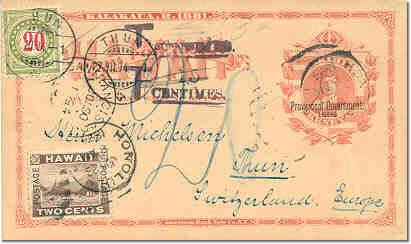
This 1¢ UX5 postal card was postmarked at Honolulu on Jan 23, 1894 and has a 2¢ brown Scott No. 75 and should have been
an overpayment of the 2¢ rate. Instead, it was taxed 15 centimes (3¢) at Hawaii as
unpaid. Switzerland changed the amount of deficiency to 2¢ and doubled it to 20
centimes (4¢) to collect from the recipient. Confusion about the rate is obvious from
the Honolulu markings. The first tax mark made was for 15 centimes due. The "15" was
stricken by pen and another "T" mark applied above it with a manuscript number which was
obliterated and a manuscript "15¢" written along side. In Switzerland a blue manuscript
"20" was written across the face and a 20 centimes postage due stamp was affixed. Thus,
it would seem the card was treated in Hawaii as unpaid for a 3¢ rate (why Hawaii thought
a 3¢ rate applied at all and why it treated this card as having no postage paid are
parts of the mystery) but was treated in Switzerland as if a 2¢ rate was fully unpaid so
the 2¢ deficiency was doubled to the equivalency of 4¢ to collect from the recipient.
Other examples of taxed cards to Europe exist in this time frame but the reason for
being taxed is unclear. Please
E-mail (scott312@earthlink.net) with information
explaining why these cards were taxed.
TAXED INBOUND
Unpaid or underpaid inbound letters or cards were taxed at double the amount of deficient
postage, the same as for outbound letters and cards.
|
|
|
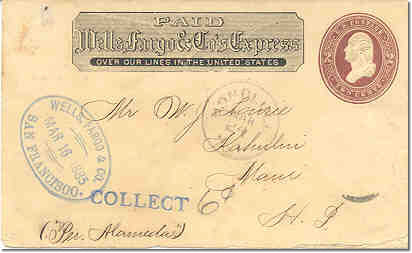
This letter was franked with only a 2¢ postal envelope so it was deficient 3¢ postage.
It was handled by Wells Fargo in San Francisco with the company's handstamp dated March
16, 1885. It was postmarked at Honolulu on March 24 and a blue "COLLECT" mark was applied
with a manuscript "6¢." This "COLLECT" tax mark is previously unrecorded as a Honolulu
mark. See Service Marks. It could be a Wells
Fargo mark. The letter has glue across the back, suggesting it was pasted onto another item - perhaps a pamphlet - and intended to go as
at a second class rate, but was rejected for that rate at Honolulu (it was sealed
so perhaps a letter rate rather than a circular rate applied). It has no San Francisco tax
mark. Please
E-mail (scott312@earthlink.net) me if you can connect this mark
to Wells Fargo.
|
|
|
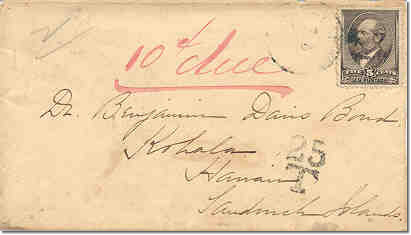
Franked with a 5¢ US Scott No. 205b, this letter was too heavy so it was deficient by 5¢
postage. At San Francisco, a "T" mark was applied for the 25 centimes underpayment.
Honolulu converted the 25 centimes to 5¢ and doubled it to collect 10¢ from the
recipient. The cover originated in New York and was postmarked at Honolulu on December
25, 1886 with postmark type 235.22. By this time, the "COLLECT" handstamp seen on the
prior cover must have been lost if it was a Honolulu mark, because the deficiency was
written by hand.
|
|
|
Here is a double weight letter originating at Vallejo, California and prepaid with 6¢
postage - leaving a deficiency of 4¢. It was given a T mark at San Francisco and rated
at 20 centimes. At Honolulu, the deficiency was converted to 4¢ and doubled except the
shortage was paid by the United States Consul General for a military officer stationed
aboard the USS Iroquois, then en route to Honolulu. It was postmarked September 28,
1889 at Honolulu.
|
|
|
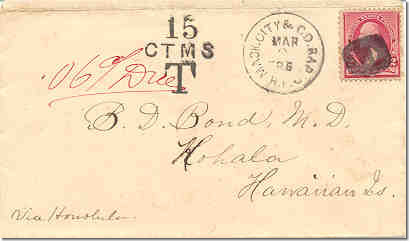
This cover bearing a Mackinaw City & Grand Rapids R.P.O. date stamp of March 2, 1892 and
a United States 2¢ stamp was underpaid 3¢, a simple case of thinking the 2¢ United States
domestic rate was enough. San Francisco applied a "T" mark for a 15 centimes deficiency.
Honolulu postmarked the cover on the back on March 22, 1892 and at some post office in
Hawaii, probably at Honolulu. a clerk wrote a manuscript ".06¢ Due" in red on the face.
|
|
|
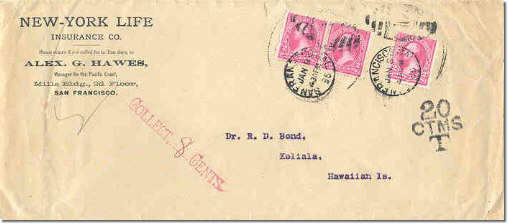
This legal size envelope was deficient 4¢ for a double weight letter and received the
usual tax marks to indicate the shortage. At Honolulu, it was postmarked January 19,
1895 and marked Collect. This version of the collect mark has a blank space for entering
the amount to be collected. See Service Marks.
|
|
|
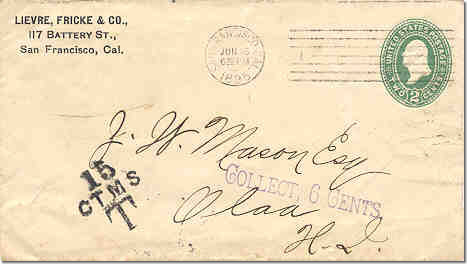
Postmarked at Honolulu on July 9, 1895, this 2¢ US Scott No. U311 envelope was deficient
by 3¢ and received the usual tax marks. The version of the Honolulu collect mark used
here has the amount built into the straightline. This cover was bound for Olaa, Hawaii,
near Hilo and was postmarked at Hilo on July 12.
|
|
|
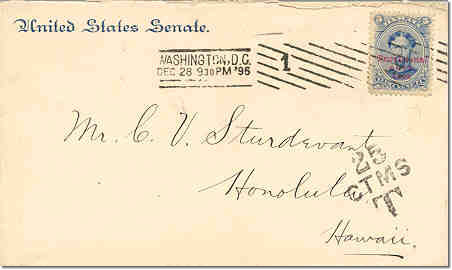
Three covers, each bearing an overprinted 5¢ Hawaiian stamp Scott No. 59 were sent from
someone at the United States Senate to Mr. Sturdevant at Honolulu. This one has no
other stamp and was rated deficient in the amount of 5¢, essentially treating it as
unpaid. Another of the three also bears only the 5¢ Scott No. 59 but was not taxed.
The third bears a United States 2¢ stamp in addition to the Hawaiian Scott No. 59 and
was not taxed. The other two covers can be found in Inbound Letters
and Micronesia Mail. Why this one letter was taxed but the others were not and
why there is nothing to show Honolulu converted the deficient amount to an amount it
would collect upon delivery are puzzles.
Taxed Inbound Postal Card
|
|
|
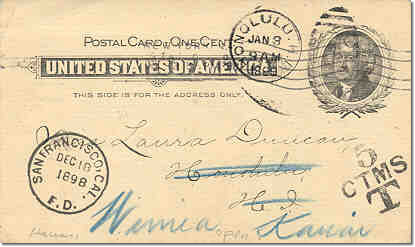
An inbound 1¢ United States card underpaid 1¢ doubled to 5 centimes (2¢) to collect from
the recipient. This card was postmarked January 9, 1899 at Honolulu.
|
|
Back to UPU Period.
|
|

|
|
Copyright © 1999 - 2010 POST OFFICE IN PARADISE. All rights reserved.
|