::: EARLY TREATY PERIOD :::
|
JULY 1, 1851 TO MAY 16, 1855
|

|
An example of a letter sent in the Early Treaty Period with Hawaii and United States postage prepaid using a
single Hawaii stamp. This cover was postmarked at Honolulu on October 3, 1854 and marked at San Francisco with a
November 1 postmark and the rocking-horse PAID/8/SHIP to indicate 8¢ was paid for United States postage. Under the
new United States letter rates effective July 1, 1851, postage from San Francisco to New York via Panama was 6¢,
plus a 2¢ per letter ship fee for transportation to San Francisco from Honolulu. When letters were prepaid in
Hawaii, the San Francisco Post Office charged the amount of United States postage to an account kept for the
Honolulu Post Office.
New Letter Rates
United States letter postage rates were reduced, effective July 1, 1851, for mail going from San Francisco to New
York via Panama. This change in United States rates gives us a new period within the Treaty Period. Hawaii soon
followed with its own reduction in foreign mail rates, effective September 13, 1851. The combined effect of these
rate reductions produced the following rates:
- On a pre-paid letter, the United States rate dropped from 40¢ to 6¢ per half ounce, starting July 1;
- On a collect letter, the United States rate dropped to 10¢ per half ounce from 40¢;
- The United States ship fee of 2¢ per letter continued in effect.
- The Hawaiian foreign mail dropped from 10¢ to 5¢ per half ounce (pre-payment compulsory) starting September
13, 1851;
Thus, from September 13, 1851, the combined cost of sending a half ounce or less letter via Panama dropped from
52¢ to 13¢ for a prepaid letter and dropped from 52¢ to 17¢ for a letter sent with United States postage collect.
A letter to a San Francisco resident still cost 6¢ per letter and one to a resident of inland California still
cost 5¢ per half ounce. See Mail Rates.
Problems applying these rates are apparent in the recorded covers and in contemporary reports, letters and
newspaper accounts. For example, Honolulu Postmaster Henry Whitney was unfamiliar with the 6¢ rate to San
Francisco until March, 1852. Other errors and misunderstandings contributed to a general confusion over the new
rates. A clearer image of what was happening is obscured by a paucity of covers from mid-June, 1851 to
mid-February, 1852.
See Log of Covers, July 1, 1851 to March 1,
1852. If you can add covers to the list, please send me an
E-mail (scott312@earthlink.net).
May 16, 1855 is used as the termination date for the Early Treaty Period because on that day Hawaii learned United
States rates increased on prepaid letters sent to the East Coast, effective April 1, 1855. From April 1 to June 6,
1855 (when the mail of May 16 arrived at San Francisco), the San Francisco post office seems to have allowed
letters from Hawaii to pass at the old rate without taxing prepaid letters as underpaid (but a forwarder cover
carried outside the mail to San Francisco with only 6¢ postage was taxed 4¢ due).
About The Early Treaty Period Covers
A total of 283 outbound covers, plus 2 large cover pieces, are recorded from the Early Treaty Period. Of these
covers, the vast majority (198) were sent stampless. Of these 283 covers, 164 were sent with United States postage
prepaid and 97 were sent with United States postage collect (the other 22 covers were sent by express, privately
carried or were free of postage), disproving a notion that in the early 1850's collect mail was more the ordinary
practice than prepaid. Stamped covers bear stamps of either Hawaii, the United States or both.
No Honolulu Postmark Until February 10, 1852
Use of the Honolulu straightline postmark, seen during the Inaugural Treaty Period
stopped on June 14, 1851. Letters sent from the Honolulu Post Office after that date until February 10, 1852,
bear no Honolulu postmark. Absence of a Honolulu postmark makes identification of the Hawaii origin of letters
difficult. Compounding this problem was the practice of the San Francisco Post Office to rate prepaid letters
showing just the United States postage without the ship fee. That practice ended May 1, 1852. Thus, letters from
Hawaii sent to the East via San Francisco and Panama had the same appearance as letters originating in San
Francisco. The absence of a Honolulu postmark may explain the dearth of covers recorded from Hawaii in the months
while there was no postmark.
|

|
This cover was sent from Hawaii in September, 1851, and postmarked at San Francisco on November 1 with an
integral "PAID 6" rate. The only way to determine the Hawaii origin is by the signature of R. C. Wyllie,
Hawaii's Foreign Minister, written on the front of the cover.
San Francisco Postmaster Moore should have rated the letters with an "8" but he rated them with a "6." The
Honolulu Post Office collected 8¢ and the San Francisco Post Office charge 8¢ to the Honolulu Post Office account,
but apparently saw no need to show the ship fee in the rates marked on the covers. Moore lacked a rating mark
with an "8" until May 1, 1852 and what rate he showed on a cover would make no difference on a prepaid letter
after leaving his office, so long as the PAID mark was applied.
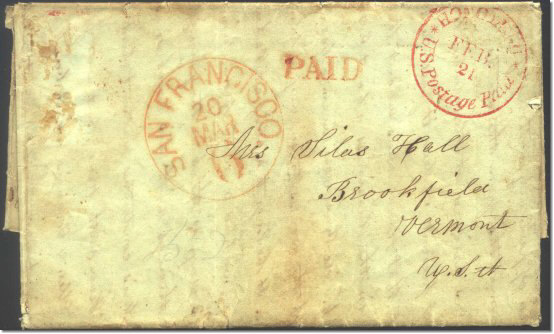
Starting February 10, 1852, the Honolulu Post Office began using new postmarks Whitney had ordered the previous
May.
|
|
One of the new Honolulu postmarks was used on this cover, dated February 21, 1852. A 13¢ Missionary stamp has
been torn from the upper left corner, leaving remnants of the stamp on this cover. San Francisco continued to
show a "6" rate when it processed this cover on March 20, 1852.
San Francisco postmarks used in this period are seen at San Francisco Postal Markings.
The Honolulu postmark with the words "U. S. Postage Paid" was only to highlight the letter so it would be rated as
prepaid at San Francisco. Otherwise, the Paid declaration in the Honolulu postmark was of no effect. Honolulu
postmarks used in this period are seen at Honolulu Postmarks.
Use of Hawaii Stamps – Prepaid Mail Sent Via Panama
Meanwhile, Hawaii joined the community of stamp issuing countries on October 1, 1851, when it put the famous
Missionary Issue on sale at Honolulu and Lahaina. Missionary covers make this
period particularly exciting. A list of recorded Missionary covers is seen at
Missionary Covers. Please send me an E-mail
(scott312@earthlink.net) with information about additional covers bearing a stamp of the Missionary Issue.
|

|
A 13¢ Missionary stamp was used on this cover to prepay Hawaii and United States postage, plus the 2¢ ship
fee on this cover postmarked at Honolulu on July 24, 1852. Addressed to Persia in care of a resident of Boston,
the letter was carried from New England to Persia by private means. Notably, the San Francisco circle "8" rate
mark was used, showing how San Francisco rated covers from Hawaii starting May 1, 1852. (Courtesy of R. A.
Siegel Auction Galleries)
In mid-1853, the Boston Engraved Issue stamps went on sale in Honolulu.
A cover franked with the 13¢ Boston Engraved stamp is shown at the introduction to this page. Lists of the two
Boston Engraved stamps used in this period are seen at Scott No. 5 and
Scott No. 6. Please send me an E-mail
(scott312@earthlink.net) with information about additional covers bearing a stamp of the Boston Engraved Issue.
Stampless Prepaid Mail Sent Via Panama
|
|
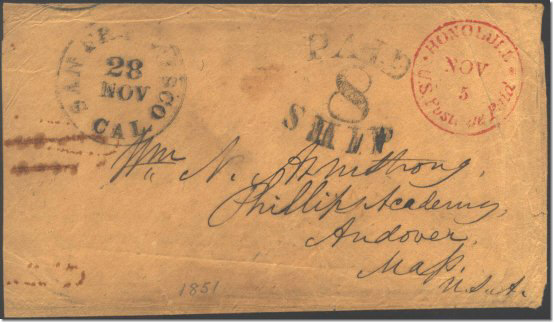
Stampless prepaid mail was handled at San Francisco the same way a cover bearing a Hawaii stamp was handled.
In September, 1853, the San Francisco post office stopped using the circle "8" rate mark (it was used again a
decade later) and switched to the large rocking-horse style "PAID/8/SHIP" mark shown on this cover postmarked
November 5, 1853, at Honolulu and November 28 at San Francisco. The letter was carried to San Francisco by the
American schooner E. L. Frost (departing November 5 departure; November 27 arrival). The Panama steamer Winfield
Scott departed San Francisco on December 1 bound for Panama but ran aground on Anacapa Island and was wrecked.
The mail, including this letter, was salvaged.
Collect Letters Sent Via Panama
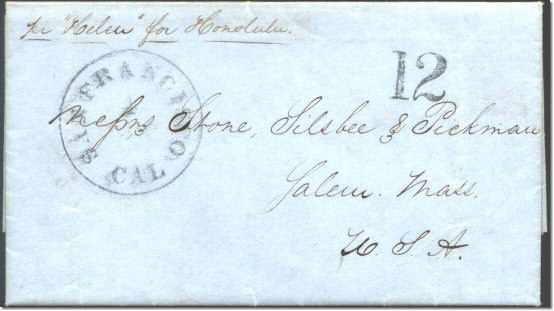
Collect letters were rated at San Francisco with the correct amount of 12¢, including 10¢ postage plus the 2¢ ship
fee.
|
|
This cover was datelined August 4, 1851 at Hobart Town, Van Diemen's Land (Tasmania) and sent to Salem,
Massachusetts via Tahiti, Honolulu, San Francisco, Panama and New York. The British brig Helen brought the
letter to Honolulu, arriving October 27, 1851, and the British brig Corsair took it to San Francisco (November 5
departure; December 2 arrival). It was postmarked December 4 at San Francisco and marked with a "12" to indicate
the incoming ship fee of 2¢ plus postage of 10¢ on collect letters sent to the East.
|

|
This collect cover was postmarked at Honolulu on April 26, 1852, after the Honolulu Post Office began using
its new postmarks. Postmark used on collect letters read "HAWAIIAN ISLANDS" across the bottom instead of "U.S.
Postage Paid". The sender paid Hawaii postage in cash and the addressee paid United States postage plus the 2¢
ship fee.
|
|
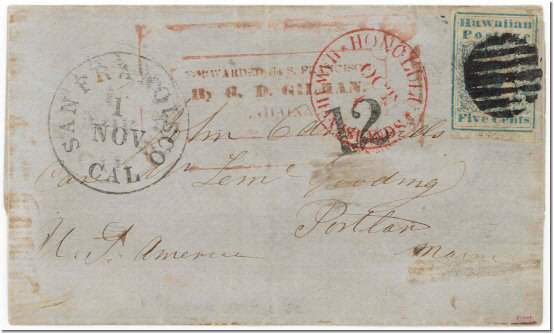
Hawaii postage was typically paid in cash, but could also be paid with a 5¢ Missionary stamp. This cover also
has a Lahaina boxed G. D. Gilman forwarding mark, indicating it was handled between Lahaina and Honolulu by the
Gilman firm. Honolulu postmarked the cover on October 4, 1852 andat San Francisco, the cover postmarked on
November 1 and marked with the typical "12" to indicate a collect letter. (Courtesy of R. A. Siegel Auction
Galleries)
|
|
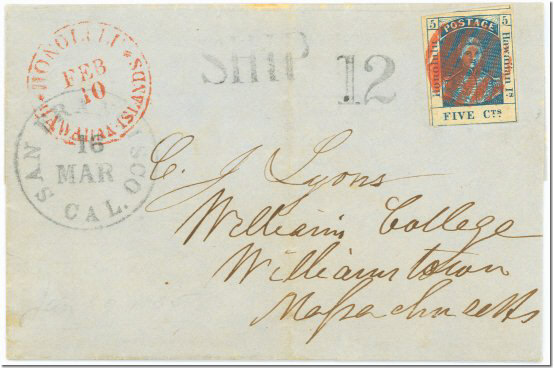
Boston Engraved stamps went on sale at Honolulu and Lahaina in mid-1853. This cover addressed to
Massachusetts was franked with a 5¢ Boston Engraved stamp, paying Hawaii postage but leaving the United States
postage unpaid. Thus, the cover was marked at San Francisco with a "12" and the word "SHIP" to indicate a
collect ship letter. The cover was postmarked at Honolulu on February 10, 1854. (Courtesy of Steven Walske)
Mail For Delivery at San Francisco
Mail sent to an addressee in San Francisco continued to require a 6¢ ship fee per letter, with no postage added.
This rate was the same as in the prior rate periods, starting with the opening of the San Francisco Post Office in
early 1849. Almost all recorded covers sent for delivery at San Francisco were sent with the United States ship fee
collect.
|
|
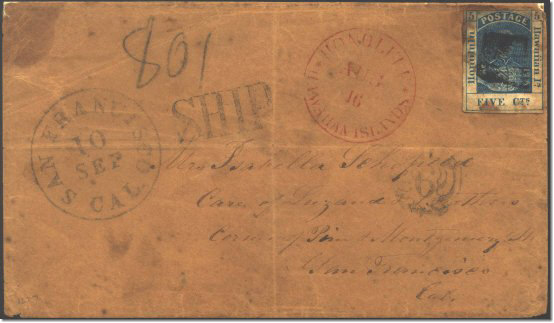
Hawaii postage of 5¢ was paid for this cover with a 5¢ Boston Engraved stamp. The United States ship fee was
left unpaid, to be paid by the addressee. Honolulu postmarked this letter on August 16, 1853. At San Francisco,
the letter was postmarked on September 10 and marked with the SHIP/6 clamshell marking to indicate 6¢ was due on
delivery. Use of the large SHIP mark was redundant, since the clamshell mark already included it, and was not
placed on most letters sent for delivery at San Francisco. Perhaps it was used on this cover because the
clamshell mark transferred poorly.
|
|
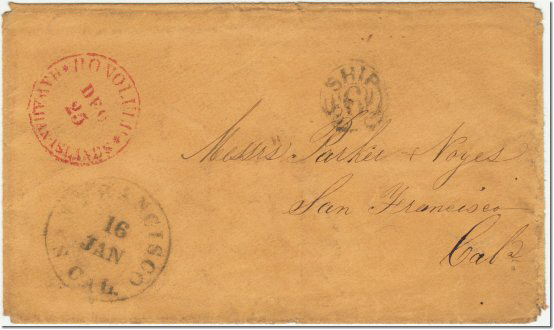
Letters addressed to San Francisco were more commonly sent stampless, with Hawaii postage being paid in cash
and the United States 6¢ ship fee collect. This example was postmarked at Honolulu on December 25, 1854, and at
San Francisco on January 16, 1855. It bears the clamshell SHIP/6, but not the separate SHIP mark, since the
clamshell mark included the word SHIP.
Mail For Delivery in the United States West, Beyond San Francisco
Letters sent beyond San Francisco for delivery elsewhere in the United States West were charged only 3¢ United
States postage per half ounce, plus the 2¢ ship fee per letter, for a total of 5¢ for a half ounce letter. Hawaii
postage of 5¢ per half ounce was charged in addition. The anomaly of charging less for delivery beyond San
Francisco remained until the early 1860's.
|
|
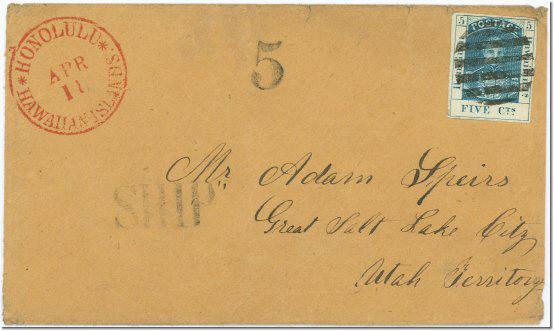
This cover was mailed to Salt Lake City, Utah, and was carried overland from San Francisco by a contract mail
route operated by George Chorpenning on the "Old Spanish Trail" from San Diego. Thus, it was rated with 5¢ due.
It was postmarked at Honolulu on April 14, 1855. Although the San Francisco Post Office marked SHIP and the 5
rate mark, it failed to postmark the cover.
Hawaii Forwarders
Forwarding services sometimes facilitated mail handling within Hawaii, particularly where inter-island transport
was involved.
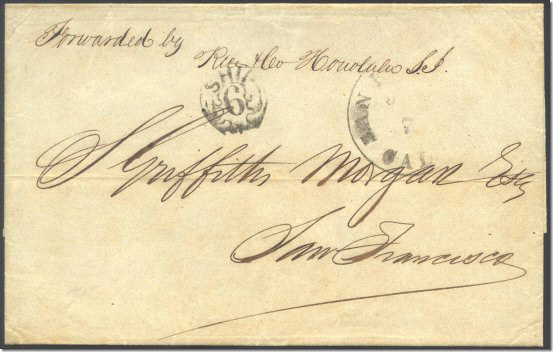
|
|
The Honolulu firm of Rice & Co. handled this letter sent from Manila to San Francisco via Honolulu in 1853
and wrote their forwarding mark on the cover. This letter has a Manila dateline of March 22, 1853, and a San
Francisco postmark of June 7. It also was marked with the San Francisco clamshell SHIP/6.
|

|
Thomas Spencer handled this letter at Honolulu and marked it with his forwarder stamp. The Honolulu Post
Office postmarked the cover on November 2, 1852 and San Francisco postmarked it on December 1 and marked its
large "12" to indicate the amount due on delivery.
Use Of United States Stamps At Honolulu
Honolulu Postmaster Whitney stocked United States stamps for use at the Honolulu Post Office. The first record of
his stamp purchases is September 11, 1852, when he ordered $50 worth of 3¢ United States stamps from the San
Francisco post office. He probably had them in hand by December or possibly late November. Of the Early Treaty
covers, twenty-six are recorded franked only with United States stamps. Eleven other covers are recorded franked
with a combination of Hawaii and United States stamps. One example of the latter is the unique 2¢ Missionary cover
(see Missionary Stamps).
United States stamps on Hawaiian covers in the Early Treaty Period were the imperforate 3¢ value of the 1851 issue,
United States Scott Nos. 10 or 11, and the imperforate 12¢ 1851 stamp. The three exceptions bear the 12¢, United
States Scott No. 17. When United States stamps were used to prepay United States postage in Hawaii, only the
amount of United States postage (but not adding the ship fee) was prepaid. Simply put, there was no 2¢ or 8¢
United States stamp at the time and 1¢ stamps were not available in Hawaii. Thus, the ship fee was paid in cash,
or with a 2¢ Missionary stamp, or with a 13¢ Hawaii stamp over which the United States stamps were sometimes
pasted.
When the Honolulu post office included a letter on the prepaid letter way bill accompanying a letter bag, the San
Francisco post office marked the letter paid and charged the Honolulu post office account with the proper amount
of postage. It was up to Honolulu to collect the correct amount or stand the loss. Honolulu could charge 8¢ to the
sender but put only 6¢ in stamps on the envelope. In those cases, the San Francisco post office charged Honolulu
with the deficient 2¢ and for all appearances, a letter from San Francisco to the East bearing 6¢ in United States
postage was fully paid. Thus, it was unnecessary even to mark the cover PAID.
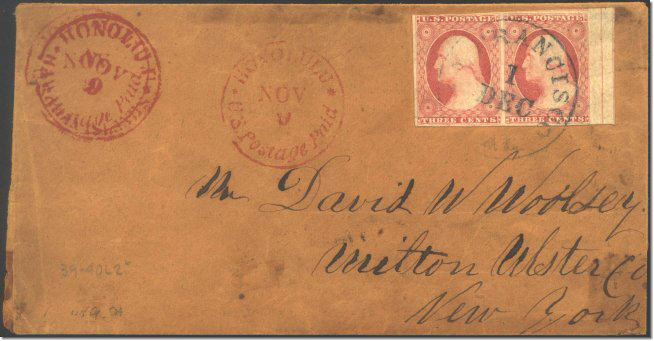
|
|
Typical of covers franked with just United States stamps is this letter postmarked at Honolulu on November 9,
1854, and at San Francisco on December 1. The only unusual feature of this cover is the use of the wrong
postmark at Honolulu. The clerk at first marked the cover with the Honolulu postmark for collect letters, but
corrected the error. The sender paid 13¢, consisting of the Hawaii rate of 5¢, the United States 2¢ ship fee and
United States 6¢ postage. A pair of United States 1851 3¢ stamps was put on the cover. The San Francisco Post
Office charged 2¢ to the Honolulu Post Office. Notably, there is no San Francisco PAID marking, consistent with
the way it treated prepaid letters originating at San Francisco. An interesting feature of this cover is that it
was taken to San Francisco by one of the early steamships, the side-wheel naval steamship USS Mississippi.
Almost all transportation between Honolulu and San Francisco in this period was by sailing ship.
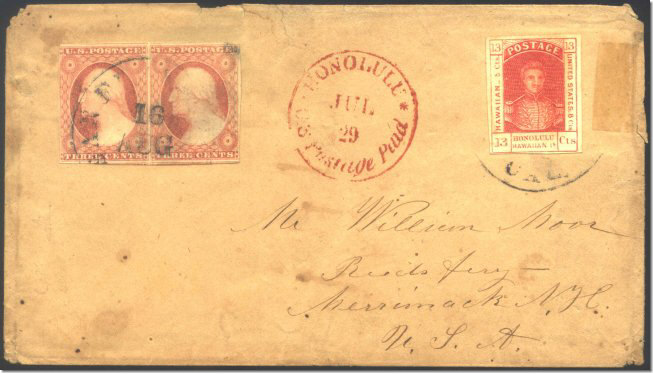
In some cases, the Honolulu Post Office affixed United States stamps over a Hawaii stamp, creating a "paste-over"
cover. It is thought this practice emanated from concern the Hawaii stamp would create confusion, but the practice
was inconsistent and may have been the preference of the patron rather than a practice of the post office.
All paste-over covers are found in 1854 or 1855.
|
|
A "paste-over" cover with the United States stamps lifted and moved so the Hawaii stamp beneath them can be
seen. The San Francisco postmark tying the pair of United States Scott No. 11 stamps can be seen on the envelope
below the Hawaiian stamp. This cover was postmarked July 29, 1854, at Honolulu and August 16 at San Francisco.
Mail Sent Through The United States To Other Destinations
Once a letter from Hawaii was entered in the United States mail at San Francisco, it was treated the same as a
letter originating there. Thus, once the sender of a letter from Hawaii paid the Hawaiian 5¢ postage and the 2¢
ship fee, the letter was charged whatever rate was due under the United States postal arrangement with the
destination country.
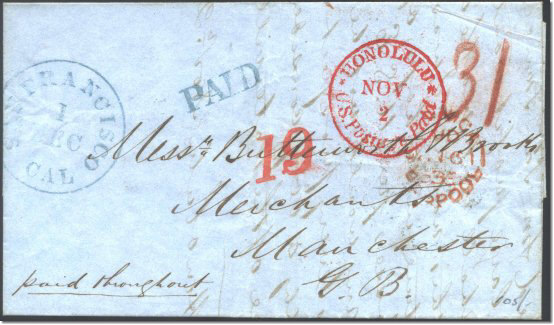
|
|
Postmarked November 2, 1852, at Honolulu and December 1 at San Francisco, this cover shows the scarce blue
San Francisco marks, used only in December, 1852 and January, 1853. The rate marks are consistent with United
States rates on a letter to England. The red manuscript "31" refers to the total amount of United States postage
plus the 2¢ ship fee paid on this letter. 5¢ Hawaiian postage was collected in cash before the letter left
Hawaii. The letter was carried from New York to England by the American packet and 3¢ was credited to England
for the amount of English inland postage included in the 31¢.
Mail Sent To Destinations Other Than Through The United States
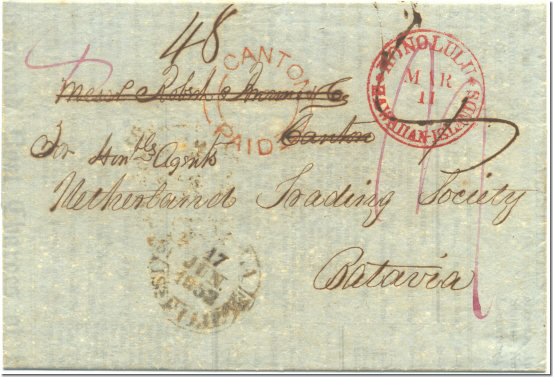
Few letters to other Pacific destinations in the Early Treaty Period are recorded. These letters often were handled
privately but one was entered in the official mail. That cover is the famous "Batavia Cover" shown below.
|
|
 Backstamps Backstamps
|

|
Postmarks front and back of this cover are Honolulu, March 11, 1852, Manila, May 19 and June 17, Hong Kong,
June 21, Canton, July 2 along with a Canton PAID mark, and again Hong Kong on July 22. This cover, addressed to
Batavia via a forwarder in Canton, was carried to Manila by the Bremen bark Ceres, departing April 3, 1852. The
letter next went from Manila to Hong Kong and paid a single letter rate of 4 pence (represented by the black "4"
over the Honolulu postmark). At Hong Kong, the letter was sent to the forwarder in Canton at another 4 pence
rate (represented by the red "4" in the upper left corner). The forwarder crossed out his name, paid postage to
Singapore (1 shilling represented by a red squiggle over the Honolulu postmark) and sent it back down to Hong
Kong. From Hong Kong, the letter was carried to Singapore by the P&O steamship Malta (July 23 departure; July 31
arrival) under British mail contract, and then to Batavia by local shipping. The "48" is said to represent a
Batavia local rate, typically written with the same type of ink.
Inbound Letters
|

|
Contents are datelined May 21, 1852 at Bradford, Connecticut. This letter is an example of a letter sent to
Hawaii with United States postage unpaid, requiring Honolulu to collect the United States postage as well as the
Hawaiian postage. The black "10" manuscript refers to the United States postage to be collected (charged to the
Honolulu post office account by the San Francisco post office). The red "5" refers to the Hawaiian postage to be
collected. On incoming letters, Hawaii paid the 2¢ ship fee from the 5¢ postage it collected so the addressee
paid only 15¢ for this letter, whereas an outbound unpaid letter cost the sender 5¢ and the recipient 12¢. Ship
captains bringing mail to Hawaii were paid nothing by the San Francisco office, which was authorized to pay only
for letters brought to the office. Thus, captains demanded their fee from the Honolulu office on incoming mail.
|

|
An example of a fully paid inbound letter is this one, dated at Westerly, Rhode Island, on September 15, 1852
and postmarked there on September 17. United States postage was paid to San Francisco.
|
|
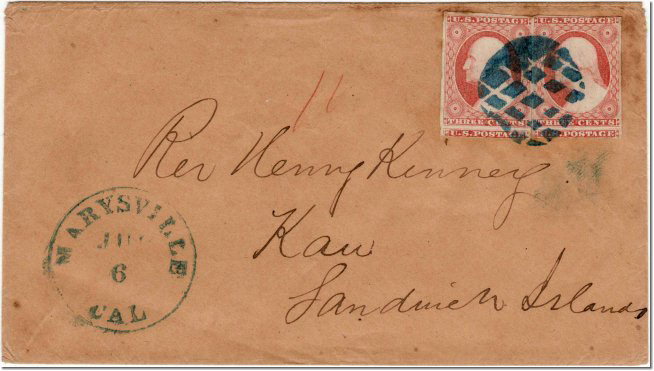
This double weight cover was mailed at Marysville, California and postmarked there on July 6, 1853. United
States postage of 3¢ (x2) was paid to San Francisco. At Honolulu, the cover was rated with a "10" to pay double
the Hawaii rate, collected from Reverend Kinney, who lived at Waiohinu at the south end of the Big Island.
Privately Handled Mail
Owing to the absence of a contract mail route between Honolulu and San Francisco, it was necessary for an agent to
retrieve Hawaii bound letters from the San Francisco post office. Where the letter was handled in the official
mail, the letter was picked up by the appointed Hawaiian agent. However, private forwarders in San Francisco were
also used to arrange for delivery of letters to an appropriate vessel.
|

|
One forwarder frequently used in this time frame was the firm of G. B. Post & Co. That firm also was the
appointed mail agent for Hawaii in 1852-1855. Starting in late 1854, G. B. Post & Co. began using a handstamp to
designate the name of the vessel carrying the letter, probably to promote the line of sailing ships. The
handstamped ship name only appears on letters handled privately by that firm and is not known on mail handled in
the official mail bags because G. B. Post & Co. could not open the bags. This letter was sent on January 14,
1855. Three styles are recorded for the schooner Vaquero, suggesting the markings were made up for each trip.
|
|
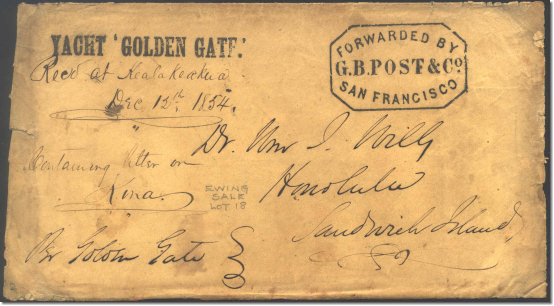
This inward cover arrived at Honolulu on December 4, 1854 and bears the unique YACHT 'GOLDEN GATE.' vessel
handstamp used by G. B. Post & Co. It arrived at its destination in Kealakekua on December 12, according to the
docket note. The Golden Gate made just one trip from San Francisco to Honolulu.
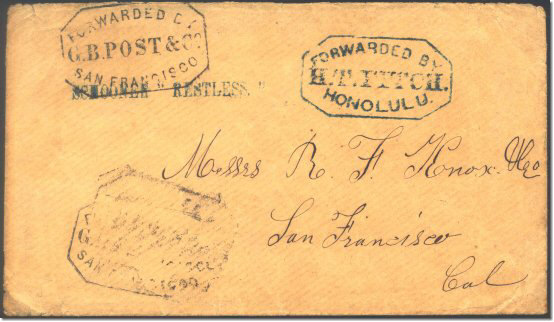
Outward covers handled by the G. B. Post service are fewer.
|
|
This outbound cover to San Francisco left Honolulu on July 13, 1854, aboard the schooner Restless and bears
the SCHOONER "RESTLESS." vessel marking in blue, along with the usual G. B. Post & Co. octagon and also with the
rare H. T. Fitch Honolulu octagon. Fitch was one of the Honolulu merchants who partnered with Post to operate
the express service.
Panama Railroad and Other Transport Routes Beyond San Francisco
Construction of a railroad between Navy Bay, near Chagres, and Panama City was commenced in 1850. By 1852, the
railroad extended from Navy Bay to Gatun and the steamer terminus was transferred from Chagres to a new settlement
on Navy Bay named Aspinwall (Colón). In July, 1852, the railroad reached the Chagres River crossing at Barbacoas,
only an hour from Gorgona by river boat, where progress halted until a bridge was completed on November 26, 1853.
Gorgona now was reached in less than a day from the Atlantic side, where it previously took three days.
Construction started toward the summit from Panama City on the Pacific side in January, 1854, and reached the
summit in October. On January 28, 1855, the first train crossed Panama from the Atlantic to the Pacific. Mail
arriving at Panama from San Francisco on January 30 was the first carried the full distance by railroad. The trip
that required four days from Chagres to Panama or two days from Panama to Chagres was reduced to four hours in
either direction. Mail departing Honolulu on the schooner Restless on December 25, 1854 was sent from San
Francisco by the steamer Sonora on January 16, 1855, the first mail to cross the full width of the Isthmus by
railroad.
Another Isthmus Route was opened across Nicaragua in 1851, but was not an official mail route. Private expresses
and forwarders directed some newspapers and mail to this route as it was perceived to be quicker.
Overland mail routes by land from California only reached as far as the Rocky Mountains during this rate period. A
contract mail route run by George Chorpenning went between Sacramento, California, and Salt Lake City from July 1,
1851 to 1854. Chorpenning renewed the contract in 1854, but shifted the route to go between San Diego, California
and Salt Lake City.
BIBLIOGRAPHY
Bash, John K., "A Census of the Hawaiian Missionaries", The Collectors Club Philatelist, Vol. XXXI, No. 4., p.
183-192, July, 1952. Census and excellent descriptions of each Missionary cover Bash was able to record - still the
standard reference even though in need of supplementing (see the census in volume 1 of the Advertiser Collection
auction catalogue listed in the General Bibliography). Bash correctly notes Scott
No. 4 was issued at least by April, 1852.
|
|
|

|
|
Copyright © 1999 - 2009 POST OFFICE IN PARADISE. All rights reserved.
|
|